
Mr Montpetit from La Présentation believes that an in-depth dialogue is necessary if the proposed bill to privatize certain aspects of electrical energy is presented in the National Assembly in the coming month. If Mr Legault wants to privatize Hydro-Québec, then he should be willing to put his arguments forward in the media.
Privatizing Hydro-Québec
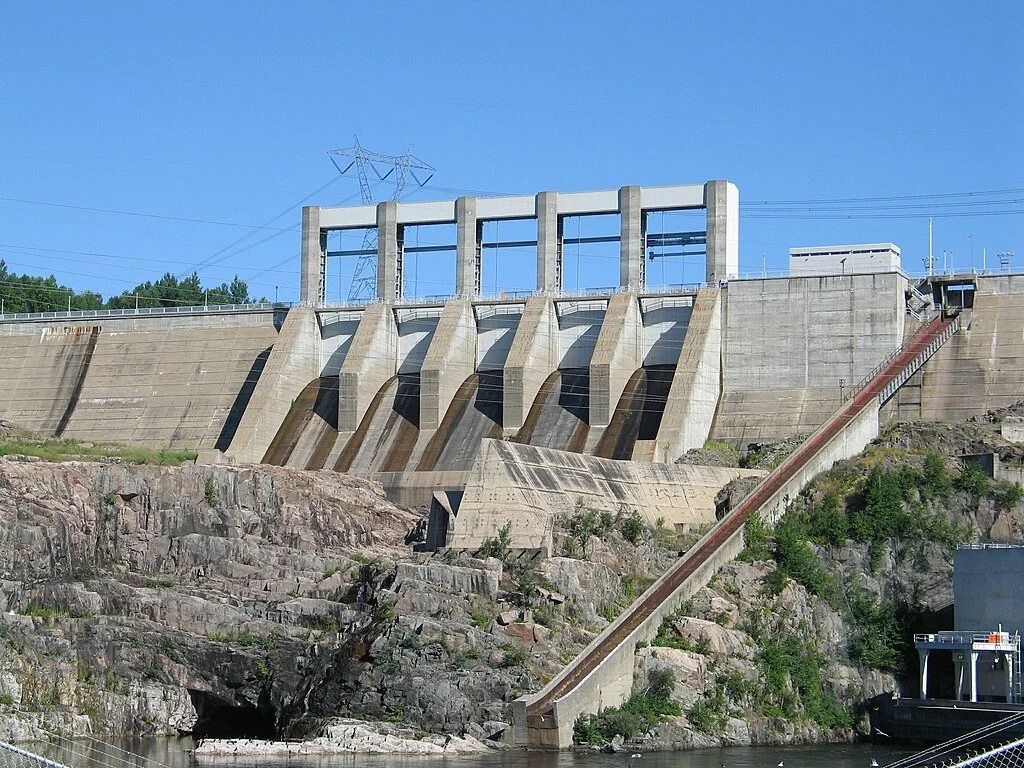
The CCCPEM (Citizens committee for the Protection of the Yamaska River basin) in collaboration with several groups welcomes you to this space which overlooks the T.-D.-Bouchard mini hydro power dam. This is symbolic because Télesphore-Damien (TD) Bouchard was the senior minister in the cabinet of Premier Adélard Godbout who instigated the law creating Hydro Québec and who, on the 15 of April 1944, proceeded to the FIRST nationalization of electricity by taking possession of the ‘Montreal Light, Heat and Power’. (1) Two decades later, M. René Levesque, a member of the cabinet of Premier Jean Lesage, was to finish that work following the election of 1962, when the theme of the ballot was ‘Masters in Our Own House’(Maîtres chez nous). The irony is that the mini power station which bears the name of the founding father of Hydro-Québec is now the property of ‘Algonquin Power’, a company with its headquarters in Ontario.
First of all, we affirm loud and clear, that we are in favour of the energy transition. The climate disasters of 2023 leave us no choice. Humanity must change its behaviour. But how? In what way? One example which has a lot to say about the ambiguous manner of doing things. At Saint-Basile-le-Grand, some twenty kilometres from here, the construction of the first part of the Northvolt mega-factory is proposed without holding any BAPE (Québec’s environmental hearings agency) hearings(2). However, the Northvolt battery factory is only one piece of the energy transition puzzle. As a bonus, a genuine debate would be a great tool to raise awareness of the advantages AND drawbacks of each type of energy; this understanding of the stakes would facilitate social acceptability.
This is why, on July 20th,,2023, our citizens’ committee formally requested a generic (or industry wide) BAPE. We believe a public debate on all renewable energies is urgently required; wind, solar, hydrogen, geothermal, renewable natural gas, ethanol, the battery industry without forgetting energy efficiency. In addition, the government is considering the possible construction of new dams and even the resurrection of Gentilly 2(a nuclear generating facility) The choices which we make today will set our future for the 21st Century; we cannot afford to make mistakes.
As for wind power, private companies (Boralex, Innergex, Hydromega, EDF, etc) are responding to the call for tenders from Hydro-Québec. The answers to these tenders had to be fast-tracked; last year, the tenders came out in March and the answers had to be in by mid-September! In order to be ready for a project, these companies crisscrossed our MRCs (regional grouping of municipalities) to get contracts signed by the owners of the best agricultural land in Québec.Contrary to other provinces or states, only 2% of Québec’s territory is good arable land. Thousands of acres are under contract to the Innergex company in the neighbouring municipalities of Sainte-Hélène and Saint-Hugues. Why build these behemoths, higher than a skyscraper such as Place Ville-Marie, on our limited food-producing acreage?Other questions which we ask here, near the power station, which honours the name of the founding father of Hydro-Québec: Why this extraordinary hurry? Why this behind closed-doors predatory bargaining by private companies? Why can’t Hydro-Québec be the project manager for the well-being of all Québecois? As argued by the public service union in a series of ads, we have constructed Hydro-Québec TOGETHER! (3) Will the private sector bring us back to the hated « Trust de l’électricité » of the 1930s?? This debate brings us back to the difficulty of reconciling the public good with the notion of profit. The ‘Council of Canadians’ has published a series of articles on the subject. (4) (5)
It is in this context that the jurist and sociologist, Richard Langelier, with the collaboration of another jurist, has conceived a municipal by-law in order to reaffirm the competence of the municipalities in the management of their territory. ‘This propose by-law spells out the rules which should apply equally to the promoters as well as to the municipal councils, so that the development of the whole renewable energy sector on municipal territory becomes truly socially acceptable. It re-affirms that production of energy projects should be conceived from the point of view of the collective interest and not that of private promoters.’
In this beginning of the 21st century, the common good is at the heart our demand. Our electricity has been the symboland the economic locomotive of our society since the Quiet Revolution with its ‘Masters in Our Own House’. It wasavant-guard! It was visionary! If humanity decides to reduce its dependence on fossil fuels, electricity will necessarily have an even more important place in our lives. For 3 decades, the CCCPEM has worked for a better environment in our midst. In order to do that, we were inspired by the theme of the Rio accord: ‘think globally, act locally’. Yes, we act locally on behalf of ‘la MRC des Maskoutains’, but our action against the denationalization of Hydro-Québec is intended as an action which includes the whole of Québec.
The government of Mr Legault is getting ready to vote a law in ‘L’Assemblée Nationale’ to allow the production of electricity by the private sector; for the moment, we do not know the exact parameters of this plan(6) If the government wants its action to be legitimate in its denationalization plan (even partial privatization) it will require a broader debate which must at least be equal to the debate held during the referendum-style election of 1962 where the political platform was nationalization of electrical energy. The water which flows over the turbine of Algonquin Power ‘is worth its weight in gold’ as said in Le Courrier de Saint-Hyacinthe. (7) Never again should a private company, whose sole obligations is to its shareholders, be able to renegotiate from a position of strength to reduce the royalties owed to the citizens of Saint-Hyacinthe because the flow of the river is insufficient.(8) We proclaim, loud and clear, that the water that flows in the river, like the wind that blows above our fields, is not the property of faraway shareholders. (9) This water belongs to all humans and all the living creatures which live in the 4 784 square kilometres of the Yamaska river water shed.(10)
Gérard Montpetit
Saint-Hyacinthe, 7th of March 2024
References
1] http://www.hydroquebec.com/histoire-electricite-au-quebec/chronologie/marche-vers-etatisation.html
3] https://scfp.qc.ca/nos-energies-a-nous/
4] https://canadians.org/analysis/who-benefits-from-false-solutions-to-the-climate-crisis/
5] https://canadians.org/analysis/who-benefits-from-unjust-and-damaging-renewable-solutions/
7] https://lecourrier.qc.ca/des-revenus-bruts-de-13-millions-en-20-ans/
8] https://lecourrier.qc.ca/la-ville-reduit-ses-pertes/
9] https://lecourrier.qc.ca/la-petite-centrale-t-d-bouchard-en-avons-nous-vraiment-besoin/
10] https://amecq.ca/2017/06/30/projet-de-cooperative-gerer-centrale-t-d-bouchard/